Digital Marketing Trends 2025: What Businesses Must Know
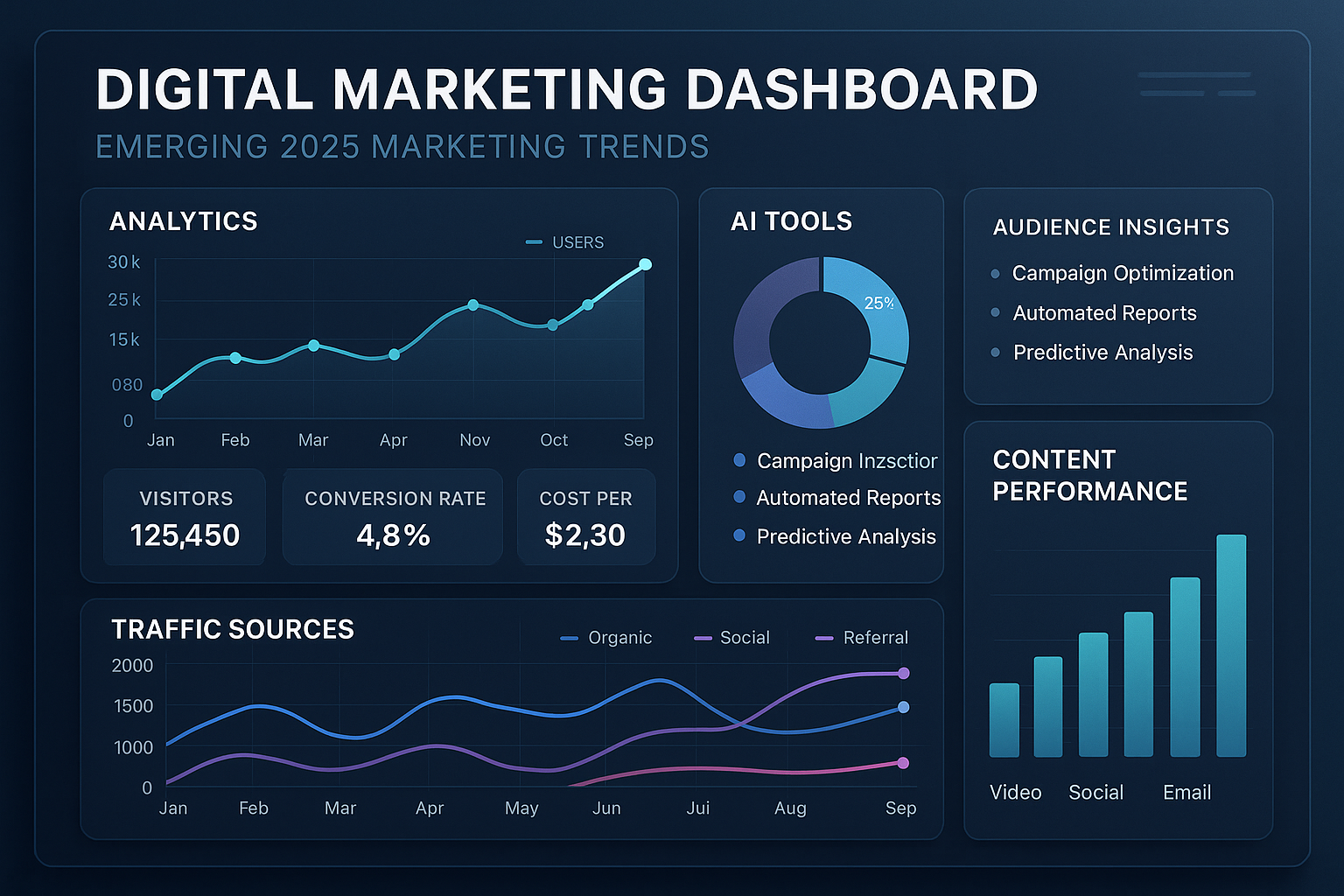


The Rapid Evolution of Digital Marketing in 2025
If you’ve felt like marketing is changing faster than ever, you’re not imagining it. Consumer expectations continue to rise, platforms evolve, and new technologies are shifting how brands connect with people across the United States. For many businesses the real challenge isn’t a lack of tools, it’s knowing which digital marketing trends actually matter and how to apply them profitably.
Three forces shape the landscape for 2025: smarter AI, hyper-personalization, and a stronger demand for authenticity and sustainability. Those shifts affect everything from programmatic inventory buying to short-form content and performance measurement. This guide breaks down the trends, illustrates real use cases, and gives practical next steps so you can move forward with confidence.
Why Digital Marketing Trends Matter in 2025
Digital marketing trends aren’t buzzwords: they signal where consumer behavior and platform economics are heading. Staying current helps brands avoid wasted spend, focus teams on high-impact tactics, and make smarter investments in channels and technology. Benefits of tracking trends include:
- Clearer cross-team alignment and fewer duplicated efforts
- Faster, data-driven decision making that responds to market shifts
- Stronger audience relevance through improved personalization
When businesses recognize and act on key trends early, they gain a measurable advantage in visibility and customer engagement.
The Top Digital Marketing Trends Transforming 2025
Below are the most consequential trends shaping strategy, creative, and media in 2025. Each section includes practical guidance and linkable resources to help execution.
How AI-Driven Content Evolution Accelerates
AI is no longer a novelty: it is the backbone of content scaling and insights. Marketers use generative models to draft copy, accelerate creative testing, and identify content gaps. AI also automates repetitive workflows like tagging, caption generation, and predictive A/B testing, freeing teams to focus on strategy and storytelling.
Practical action: build a human + AI content process where AI drafts and tests variants, and human editors refine voice, accuracy, and brand fit. For an intro to marketing fundamentals that complements AI workflows, check this beginner’s marketing guide.
How Hyper-Personalized Experiences Expand
Personalization in 2025 goes beyond “Dear Jane.” It uses cross-channel signals to tailor offers, creative, and experience flows in real time. Brands that can map intent signals and serve timely, relevant content see higher conversion rates and stronger retention.
Pro Tip: start with one channel—email or onsite—and expand to omnichannel personalization as data maturity grows. Learn how campaigns translate to outcomes by reviewing relevant services and case studies.
Programmatic Maturity: What’s New in Programmatic Ads
Programmatic continues to dominate media buying, but 2025 brings refinements rather than an overhaul. Expect more emphasis on transparency, contextual targeting, and unified measurement. If you follow programmatic advertising trends 2025 and 2025 programmatic advertising trends, you’ll notice buyers prioritizing clean supply, first-party data, and measurement lifts over sheer reach.
Advertisers should understand programmatic advertising explained: automated bidding across many exchanges, using data signals to place ads in real time. Programmatic ads now integrate with offline conversions, giving a clearer picture of business impact.
Short-Form Video and Creative Serialization
Short-form video remains the top engagement format on platforms like TikTok and Instagram Reels. The key 2025 creative shift is serialization: brands build short sequences that guide users through awareness to conversion without losing attention.
Actionable tip: treat each short video as an episode in a funnel—tease, educate, and close—with creative templates that scale.
Advances in Voice, Conversational Search, and Zero-Click Discovery
With wider smart speaker and assistant use, conversational queries are influential. Optimizing for voice search means using natural language, structured data, and FAQ content that answers query intent succinctly.
Pro Tip: create FAQ clusters that target question-based long tail keywords to capture voice and zero-click traffic.
Measurement, Privacy, and Ethical Data Practices
Third-party cookie deprecation and stricter privacy expectations require marketers to embrace privacy-first measurement: consented first-party data, probabilistic modeling, and on-device signals. Brands that are transparent about data use and prioritize consumer trust stand to win long-term.
Sustainability as Differentiator: Sustainable Digital Marketing
Sustainability moves from messaging to operational practice. In 2025, sustainable digital marketing means optimizing media to reduce waste (fewer irrelevant impressions), choosing eco-conscious vendors, and highlighting verifiable ESG practices in campaigns.
Practical move: audit media efficiency and shift budgets to high-performance, low-waste placements.
Platforms, Planning, and Reach Optimization: Choosing the Best Tools
Media planners need consolidated views of reach and frequency across walled gardens and open web. The best platforms for media planning and reach optimization 2025 combine deterministic platform data with high quality panel and modeled measurement to plan and decompose reach.
Recommended workflow: adopt a planning layer that ingests platform reach curves and overlays campaign KPIs to optimize budget allocation. For examples of campaign work and creative execution, review this our work portfolio and client case studies.
Real-World Applications of 2025 Digital Trends
Here are practical examples of how businesses apply these trends.
- A retailer uses AI to auto-generate 20 creative variants, and programmatic targeting to serve the best creative to each micro-audience segment, reducing CPA by double digits.
- A B2B services firm uses short-form video and personalized landing experiences to accelerate lead qualification.
- A nonprofit adopts sustainable digital marketing practices by minimizing wasted impressions and using less energy-intensive creative formats.
For tactical implementation, align your team’s capabilities with vendor selection and test one trend at a time to measure lift.
Best Practices for Adapting to Digital Trends
- Audit your martech stack boldly and retire underused tools.
- Adopt a test-and-learn culture: small experiments scale into winning programs.
- Maintain consistent brand messaging across emerging channels.
- Invest in analytics and consolidated reporting to speed decisions.
For hands-on execution and services, see this services overview.
What These 2025 Digital Marketing Trends Mean for Your Business
Digital marketing in 2025 rewards speed, relevance, and trust. Brands that embrace AI responsibly, prioritize privacy, optimize programmatic buys for transparency, and adopt sustainable practices will outpace competitors.
Start small: pick one trend—AI content automation, programmatic optimization, or short-form video—and develop measurable tests. As you learn, expand capabilities and partner with specialist providers for scale.
For ongoing industry perspectives and playbooks, follow thought leadership from outlets like Search Engine Journal and social media research from Sprout Social.
Frequently Asked Questions About Digital Marketing Trends
- What are the biggest digital marketing trends for 2025?
Top trends include AI-driven content and insights, hyper-personalization, programmatic maturity, short-form video dominance, voice search optimization, and heightened data privacy expectations. - How will AI impact digital marketing strategies?
AI automates content generation, personalization, and analytics. It accelerates testing and helps marketers focus on creative strategy and audience understanding. - Can small businesses benefit from these trends?
Yes. Small businesses can leverage short-form video, local SEO, and affordable AI tools to level the playing field and improve customer experience. - Why is personalization becoming more important?
Personalization reduces friction and increases relevance, which leads to higher conversions and stronger customer loyalty.
What role does data privacy play in 2025 marketing?Data privacy shapes consumer trust and legal compliance. Brands must implement transparent consent flows, minimize unnecessary data collection, and use privacy-first measurement.
Contact Us
